One of the World’s Most Stubborn Central Banks Gives In | Bloomberg
South Korea’s surprise rate cut is welcome, but the economy needs deeper changes to crawl out of this slump.
Laura Ingraham : Exposing the left’s hollow calls for national unity | Fox News
Peter Navarro: Inflation will hurt the working poor | Saturday Agenda
오징어 게임 무엇이 문제인가?
오징어 게임 문제의 본질은 한국 좌파 문재인 정권의 실패한 사회주의 정책의 민낯!
블룸버그, “문재인의 사회주의 실험으로 한국경제가 무너져 내렸다”“한국은 외부요인 문제보다 내부요인 문제가 더 심각하다. 지난 2년간, 문재인 대통령의 사회주의적 실험은 한국 경제의 ‘야성적 충동(animal spirits)’을 죽여버렸다”
한국 경제의 불평등한 구조가 점차 심각해진 계기는 문재인 정권의 사회주의 실험 실패와 기생충처럼 국가의 세금을 뜯어먹는 친중파, 친북파 80년대 운동권들 그리고 좌파 시민단체들에 대한 제재와 합당한 법적 조치가 없었기 때문이다.
한국의 문재인 정권의 경제 사정에서 비롯된 것이며, 한국의 경제적 불안에서 출발한 것이다.
한국의 경제는 물가와 부동산은 폭등하는데 비해, 개개인의 소득은 점차 줄고 있다.
한국 국가 경제의 불평등한 구조적 문제에서 기인했으며, 한국 국가 경제의 불평등은 오늘날 오징어 게임과 매우 유사하다.
급속 성장 과정에서 심화한 한국 내 소득 자산은 불평등한 구조를 보여주고 있다.
한국의 국가 경제 불평등이라는 주제가 오징어 게임처럼 삼류 드라마가 유명해질 수 있는 이유이다.
MZ 세대의 기회와 과정의 공평성을 처참히 짚 발아 버리고 불행을 던져준 사람들은 바로 대학시절부터 허세로 똘똘 뭉쳐 지식을 채우지 않고 시위만 했던 자칭 민주화 운동권 정신병자들 때문이다.
그들의 잘못된 이념과 신념은 한국의 경제 성장의 동력을 처참히 부숴버렸다. 이 정신병자들을 사회적으로 격리 시키지 않는다면 한국은 경제적 위기를 넘어 심각한 재난이 닥칠 수 있다.
« 아시아 호랑이였던 한국경제, 文의 사회주의 실험으로 ‘개집 신세’ 됐다 »…블룸버그 신랄한 비판
South Korea at Risk 위기의 대한민국 (한/영자막) | OKN
오징어 게임의 문제를 지적한 한국 댓글 소개!
[한국 댓글 1]
오징어 게임은 자본주의 빈부 격차를 비판하는 드라마가 아니라, 딥스의 통제 시스템을 홍보하는 프로파간다(propaganda) 드라마입니다.
[한국 댓글 2]
감독이 좌빨이라 본인은 그렇게 생각했는지 몰라도 현실에서 거대 권력은 딥스입니다. 딥스의 꼬붕은 공산당이고, 왜 좌파 정권에서 더 통제 정책과 불평등이 일어나는지 감독은 진짜 모르는 건가?
Behind the Global Appeal of Squid Game, a Country’s Economic Unease.The dystopian Netflix hit taps South Korea’s worries about costly housing and scarce jobs, concerns familiar to its U.S. and international viewers. | TheNewYorkTimes
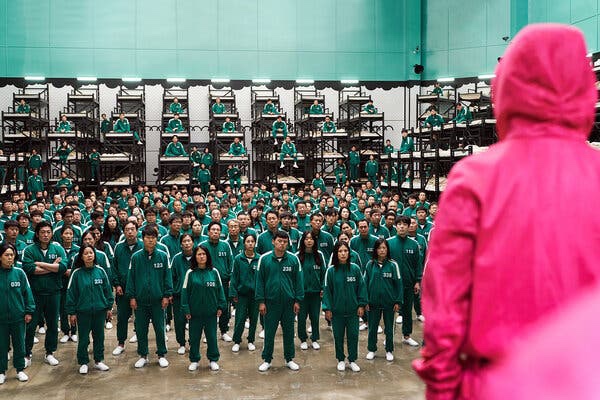
“Squid Game,” the hit dystopian television show on Netflix, 456 people facing severe debt and financial despair play a series of deadly children’s games to win a $38 million cash prize in South Korea.
Koo Yong-hyun, a 35-year-old office worker in Seoul, has never had to face down masked homicidal guards or competitors out to slit his throat, like the characters in the show do. But Mr. Koo, who binge-watched “Squid Game” in a single night, said he empathized with the characters and their struggle to survive in the country’s deeply unequal society.
Mr. Koo, who got by on freelance gigs and government unemployment checks after he lost his steady job, said it is “almost impossible to live comfortably with a regular employee’s salary” in a city with runaway housing prices. Like many young people in South Korea and elsewhere, Mr. Koo sees a growing competition to grab a slice of a shrinking pie, just like the contestants in “Squid Game.”
Those similarities have helped turn the nine-episode drama into an unlikely international sensation. “Squid Game” is now the top-ranked show in the United States on Netflix and is on its way to becoming one of the most-watched shows in the streaming service’s history. “There’s a very good chance it will be our biggest show ever,” Ted Sarandos, a co-chief executive at Netflix, said during a recent business conference.
Culturally, the show has sparked an online embrace of its distinct visuals, especially the black masks decorated with simple squares and triangles worn by the anonymous guards, and a global curiosity for the Korean children’s games that underpin the deadly competitions.
Like the “Hunger Games” books and movies, “Squid Game” holds its audience with its violent tone, cynical plot and — spoiler alert! — a willingness to kill off fan-favorite characters. But it has also tapped a sense familiar to people in the United States, Western Europe and other places, that prosperity in nominally rich countries has become increasingly difficult to achieve, as wealth disparities widen and home prices rise past affordable levels.
“The stories and the problems of the characters are extremely personalized but also reflect the problems and realities of Korean society,” Hwang Dong-hyuk, the show’s creator, said in an email. He wrote the script as a film in 2008, when many of these trends had become evident, but overhauled it to reflect new worries, including the impact of the coronavirus. (Minyoung Kim, the head of content for the Asia-Pacific region at Netflix, said the company was in talks with Mr. Hwang about producing a second season.)
“Squid Game” is only the latest South Korean cultural export to win a global audience by tapping into the country’s deep feelings of inequality and ebbing opportunities.
“Parasite,” the 2019 film that won best picture at the Oscars, paired a desperate family of grifters with the oblivious members of a rich Seoul household. “Burning,” a 2018 art-house hit, built tension by pitting a young deliveryman against a well-to-do rival for a woman’s attention.
The masked guards in “Squid Game” mete out violence during the competitions.Netflix
South Korea boomed in the postwar era, making it one of the richest countries in Asia and leading some economists to call its rise the “miracle on the Han River.” But wealth disparity has worsened as the economy has matured.
“South Koreans used to have a collective community spirit,” said Yun Suk-jin, a drama critic and professor of modern literature at Chungnam National University. But the Asian financial crisis in the late 1990s undermined the nation’s positive growth story and “made everyone fight for themselves.”
The country now ranks No. 11 using the Gini coefficient, one measure of income inequality, among the members of the Organization for Economic Cooperation and Development, the research group for the world’s richest nations. (The United States is No. 6.)
As South Korean families have tried to keep up, household debt has mounted, prompting some economists to warn that the debt could hold back the economy. Home prices have surged to the point where housing affordability has become a hot-button political topic.
Prices in Seoul have soared by over 50 percent during the tenure of the country’s president, Moon Jae-in, and led to a political scandal.
“Squid Game” lays bare the irony between the social pressure to succeed in South Korea and the difficulty of doing just that, said Shin Yeeun, who graduated from college in January 2020, just before the pandemic hit. Now 27, she said she had spent over a year looking for steady work.
“It’s really difficult for people in their 20s to find a full-time job these days,” she said.
South Korea has also suffered a sharp drop in births, generated partly by a sense among young people that raising children is too expensive.
“In South Korea, all parents want to send their kids to the best schools,” Ms. Shin said. “To do that you have to live in the best neighborhoods.” That would require saving enough money to buy a house, a goal so unrealistic “that I’ve never even bothered calculating how long it will take me,” Ms. Shin said.
Characters in the show receive invitations to participate in the Squid Game.
“Squid Game” revolves around Seong Gi-hun, a gambling addict in his 40s who doesn’t have the means to buy his daughter a proper birthday present or pay for his aging mother’s medical expenses. One day he is offered a chance to participate in the Squid Game, a private event run for the entertainment of wealthy individuals. To claim the $38 million prize, contestants must pass through six rounds of traditional Korean children’s games. Failure means death.
The 456 contestants speak directly to many of the country’s anxieties. One is a graduate from Seoul National University, the nation’s top university, who is wanted for mishandling his clients’ funds. Another is a North Korean defector who needs to take care of her brother and help her mother escape from the North. Another character is an immigrant laborer whose boss refuses to pay his wages.
The characters have resonated with South Korean youth who don’t see a chance to advance in society. Known locally as the “dirt spoon” generation, many are obsessed with ways to get rich quickly, like with cryptocurrencies and the lottery. South Korea has one of the largest markets for virtual currency in the world.
Like the prize money in the show, cryptocurrencies give “people the chance to change their lives in a second,” said Mr. Koo, the office worker. Mr. Koo, whose previous employer went out of business during the pandemic, said the difficulty of earning money is one reason South Koreans are so obsessed with making a quick buck.
“I wonder how many people would participate if ‘Squid Game’ was held in real life,” he said.

 WE THE PEOPLE